
What is Parabolic Screen?
The parabolic screen is also called the sidehill screen and run-down screen, it uses the Coanda effect to remove impurities in materials at low cost.
It is a static dewatering screen widely used in the water treatment industry.
Curved wedge wire screens offer superior solid-liquid separation efficiency compared to flat wedge wire panels.
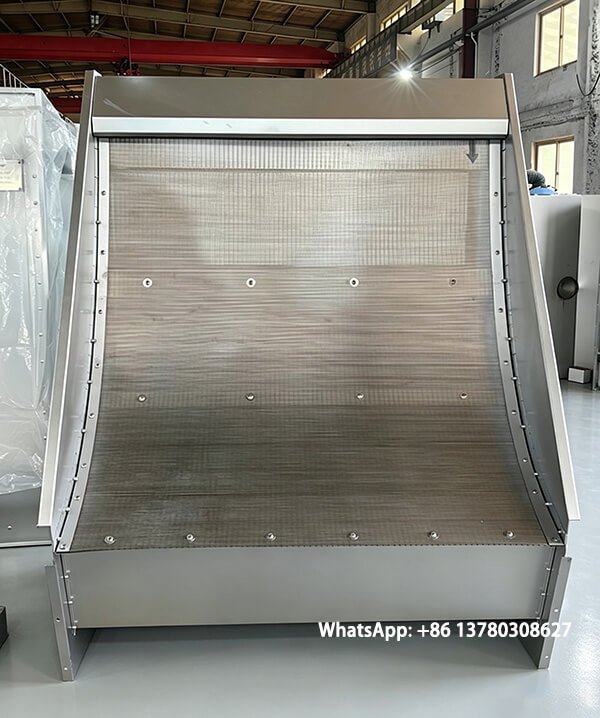
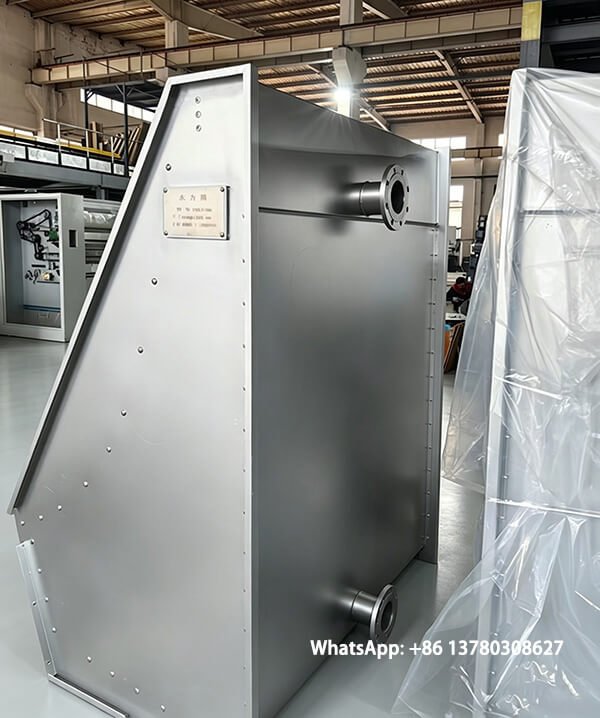
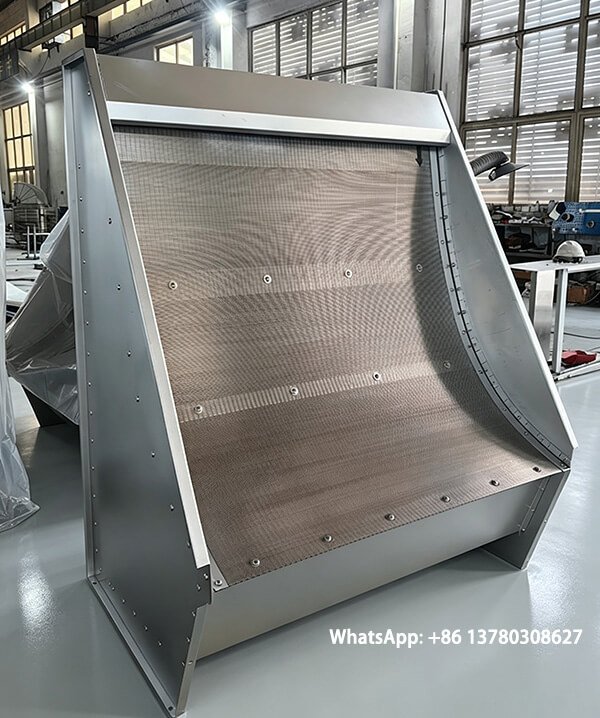
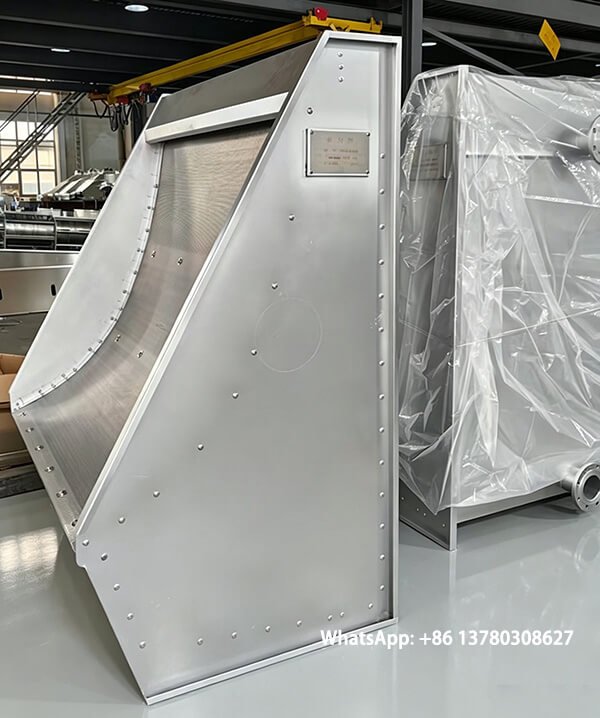
Free design services
We can design parabolic screen filter that meet the usage requirements based on customer needs.
Specifications Of The Parabolic Screen Filter
 Material: Stainless steel 304, 316, or 316L.
- Width of the sieve bend screen: 200 – 3500 mm (or as your need).
- Length of the sieve bend screen: 950 – 1800 mm (or as your need).
- Flow: Customized according to customer requirements.
- Slot size: 0.2mm – 2.0mm.
- Housing thick: 3mm or as your need.
 Material: Stainless steel 304, 316, or 316L.
Product specifications are customized by customer needs. For different requirements of capacity, the size of the product will change.
We have a professional technical team that will assist customers to design qualified products together.
Why chose us?
The key component of the parabolic screen is the high-quality wedge wire screen, we are the largest wedge wire screen (Johnson screen) manufacturer in northern China, and we have huge advantages in the production process of wedge wire screen products.
In addition to quality raw materials, the following points are also important:
- Wedge wire welding process.
We use the most advanced circular fusion welding technology on the market, which makes the welding place more firm and does not cause wire stripping. - Wedge wire tilt angle.
This is a difficult problem in the production of wedge wire mesh. We can produce wedge wire mesh products with a highly uniform inclination angle to meet the special needs of customers. - Special surface treatment technology.
Unlike ordinary pickling and polishing, we use a special physical surface treatment technology that can increase the service life of the product by more than 40%.
 Wedge wire welding process.
Upgrade model of the Parabolic Rundown Screens
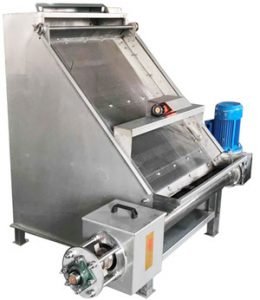 On the basis of the original we have added a spiral extrusion system, dehydration of solid impurities for subsequent processing.
(auger + screw press screen)
In addition, there is vibration on the screen, which makes it easier to clean up the debris on the screen and prevent blocking.
Working principle:
- Impurities enter the V-shaped wire screen.
- Conveyed forward under the squeeze of auger.
- During this process, impurities are squeezed, and the water that comes out flows out of the screen.
The moisture content of the impurities after dewatering is about 40%.
Advantages of Parabolic Screen
- No moving parts, low operating costs and low maintenance costs.
- Simple installation (we will provide installation video or manual).
- V-shaped wire, continuous slotted structure, not easy to block and easy to clean.
- Long service life.
Applications
Industrial and urban sewage treatment
Fruit, drinks and vegetable processing
Dewatering of waste grains in Breweries
Coal mine screening
Paper & Pulp mill
Solid liquid separation in slaughterhouse
Chemical industry
Sugar industry
Timber processing
Plastic products
Cannery
If you are interested in parabolic screen separator or want to inquire about other Johnson screen products, please leave me a message.
Working Principle of Gravity Wedge Wire Parabolic Screen
The gravity wedge wire parabolic screen, also widely named sieve bend screen, relies on the Coanda effect and natural gravity to complete automatic solid-liquid separation without any driving motor or power consumption.
The whole working flow starts with uniform material feeding. Wastewater, slurry or mixed liquid-solid materials flow down along the upper feeding chute at a certain preset flow velocity. When the liquid mixture hits the curved wedge wire screen surface, the Coanda effect occurs immediately: liquid components cling tightly to the surface of the V-shaped wedge wires and quickly penetrate the narrow screen slots, then flow into the lower water collecting tank as separated filtrate.
Solid particles, fibers, sludge and other suspended substances cannot pass through the tiny wedge wire slots. Supported by the curved arc structure and gravity sliding force, these solid materials continuously slide downward along the parabolic screen panel and finally discharge from the bottom solid outlet automatically.
Our standard parabolic screen is manufactured with a fixed optimal arc angle, which maximizes the Coanda separation efficiency and avoids material splashing. Unlike flat wedge wire screens, the curved parabolic design extends the contact time between materials and the filter surface, greatly improving separation precision and overall processing capacity.
For high-viscosity or high-concentration slurry scenarios, the static gravity parabolic screen can be matched with optional vibration auxiliary structures. Mild vibration shakes off sticky solid residues stuck on the wedge wire slots to prevent blockage, maintaining stable long-term dewatering performance.
This purely gravity-driven working principle cuts your daily operation costs sharply, with zero energy consumption and fewer vulnerable spare parts, making the wedge wire parabolic screen a cost-effective primary filtration equipment for wastewater, pulp, food, mining and manure treatment industries.
What is the difference between parabolic screen and sieve bend?
In the global industrial filtration industry, parabolic screen and sieve bend essentially refer to the same gravity wedge wire curved separation equipment, so there is no fundamental structural difference between the two products. The gap only lies in regional naming habits, market terminology and application scenarios.
“Sieve bend” is the mainstream professional term widely adopted by European, American and Australian water treatment, mining and pulp industries. This name directly reflects its core feature: a bent wedge wire screen panel used for slurry screening. Most overseas engineering consultants and equipment buyers use “sieve bend” when searching for small to medium dewatering curved screens for wastewater and food processing lines.
“Parabolic screen” is a more descriptive naming popular in Asian, Middle Eastern and Latin American industrial markets. It highlights the unique parabolic arc design of the screen surface. Buyers searching for large-capacity curved separation machines for mine slime, farm manure and high-flow industrial wastewater usually prefer to search the keyword parabolic screen.
Apart from naming conventions, the two terms cover identical core structures: stainless steel wedge wire screen slots, gravity-driven separation based on the Coanda effect, static non-motor operation and identical customizable parameters including slot size, width, length and material grade (304 / 316L stainless steel).
Our factory produces one unified curved wedge wire screen product line that matches both search terms. Whether your project requires equipment labeled sieve bend or parabolic screen, we can provide matching drawings, technical parameters and customized sizes without changing the internal separation structure.
How does a parabolic screen use the Coanda effect for separation?
The Coanda effect is the core physical mechanism that enables efficient solid-liquid separation on a gravity wedge wire parabolic screen, working together with gravity to achieve automatic filtration without extra power.
When slurry, wastewater or fiber liquid flows down the feeding chute and hits the curved wedge wire panel of the parabolic screen, liquid fluid naturally sticks to the curved metal surface due to the Coanda effect. Instead of splashing away vertically, the liquid follows the arc of the V-shaped wedge wires and quickly flows through the precise tiny slots into the filtrate collection tank below.
Solid particles, fibers, sludge and organic residues cannot pass through the narrow wedge wire gaps. Without liquid adhesion to carry them forward, these solids lose the support of fluid flow. Driven by gravity and the smooth curved surface of the parabolic screen, the separated solids slide steadily down the arc and discharge from the solid outlet at the bottom.
The specially designed parabolic arc angle maximizes the Coanda effect performance. A proper curve keeps liquid clinging to the screen surface long enough for full penetration, while preventing liquid from carrying fine solids over the screen edge. Flat wedge wire screens cannot generate this stable fluid adhesion, which is why they deliver far lower separation efficiency than parabolic sieve bend equipment.
For sticky high-concentration slurries, optional vibration accessories strengthen the Coanda separation process. Gentle vibration shakes solid buildup off the wedge wires, ensuring the liquid maintains full contact with the screen surface to sustain consistent Coanda effect filtration during long continuous runs.
This combination of the Coanda effect and gravity makes the parabolic screen a low-cost, low-maintenance primary dewatering solution widely used in pulp, food processing, mining wastewater and livestock manure separation.
What slot sizes are available for wedge wire sieve bend screens?
1. Slot size selection depends entirely on your actual application
We supply a full range of customizable slot sizes for stainless steel wedge wire parabolic screens (sieve bend screens), covering standard gaps from 0.2 mm up to 2.0 mm. Different industries and processing targets require distinct slot specifications. For example, 0.2mm–0.5mm fine slots are ideal for capturing tiny pulp fibers and fine food residues; medium 0.6mm–1.2mm slots fit municipal wastewater and livestock manure dewatering; wider 1.3mm–2.0mm slots are widely adopted for coal slime, mineral slurry and large-flow industrial wastewater filtration. Each working condition has its matching slot size to guarantee stable solid-liquid separation results.
2. Avoid overly small slot sizes to prevent clogging and low screening efficiency
Many buyers mistakenly choose ultra-narrow slots to pursue higher filtration precision, yet this choice brings obvious drawbacks. Excessively small gaps easily get blocked by viscous sludge, fine fibers and suspended solids during continuous operation. Once the wedge wire slots are blocked, liquid penetration speed drops sharply, overall processing capacity declines, and you have to stop production frequently to clean the screen surface. Constant blockage will also shorten the service life of your parabolic screen panel and raise your daily maintenance costs. Selecting an unnecessarily tiny slot size will ultimately reduce your long-term screening efficiency instead of improving separation performance.
3. Contact our technical team for tailored professional slot recommendations
With various influencing factors including slurry concentration, solid particle size, daily handling flow and material viscosity, it is hard to pick the optimal slot size without professional technical evaluation. Please share your on-site working parameters with our professional engineers in advance. Combining our rich manufacturing experience of wedge wire sieve bend screens and countless industrial project cases, we will analyze your raw material conditions carefully and provide you with the most suitable slot size solution to balance separation precision, anti-clogging performance and processing capacity. We also support custom non-standard slot sizes to satisfy special filtration demands.
Why curved wedge wire panels perform better than flat screens for dewatering?
Curved wedge wire panels deliver far superior dewatering and solid-liquid separation performance compared with traditional flat wedge wire screens, thanks to their unique arc structure and optimized profile wire design.
First, the professional curved arc surface fully utilizes the Coanda effect combined with natural gravity to achieve efficient automatic filtration. Different from flat screens that only allow simple vertical liquid penetration, the curved design enables the slurry and wastewater to closely attach to the screen surface for a longer contact time. This stable fluid adhesion significantly improves liquid filtration efficiency and greatly increases the hourly processing capacity, allowing the equipment to handle larger flow rates in the same unit time without material splashing or waste.
Second, our curved sieve bend adopts specially angled profile wedge wires instead of ordinary straight flat wires. The scientific tilt angle of the screen wires forms a continuous, smooth and unobstructed slot structure. This unique structural design accurately intercepts solid particles, sludge and fibers while ensuring rapid liquid penetration. It effectively avoids material accumulation and blockage that commonly occur on flat screens, greatly improving overall screening precision and working stability. Meanwhile, the angled profile wire structure reduces friction resistance, realizes self-cleaning effects during operation, and further enhances the long-term dewatering efficiency of the parabolic screen.
In short, the perfect combination of Coanda effect curved structure and angled profile wire makes our curved wedge wire panels more suitable for high-flow, high-viscosity industrial dewatering scenarios, with higher efficiency, larger throughput and lower maintenance costs than conventional flat screens.
Can you customize the width and length of parabolic screen panels?
Yes, full customization is available. We can tailor any width, length, size and stainless steel material grade of parabolic screen panels to match your on-site working requirements.
Is polished surface treatment standard for your parabolic screens?
Polished finish is one of our available options. We supply multiple surface treatments including pickling, polishing, anodizing, carbonitriding and more to fit different working environments.
Can you make anti-corrosion parabolic screens for chemical wastewater?
es, we fully support custom anti-corrosion parabolic screens and sieve bend panels specially designed for harsh chemical wastewater treatment environments.
Chemical wastewater usually contains acid, alkali, salt and corrosive chemical residues, which easily erode ordinary stainless steel screens and cause rust, deformation or short service life. To solve this problem, we adopt multiple anti-corrosion solutions for parabolic screens. We can upgrade raw materials to high-grade 316L stainless steel and duplex stainless steel, which deliver excellent resistance to acid corrosion, alkali erosion and salt water oxidation.
In addition, we provide professional enhanced surface treatments including pickling passivation, precise polishing and anti-corrosion coating. These processes further isolate the screen surface from corrosive liquids, effectively extending the service life of the wedge wire panel under long-term chemical working conditions.
Our anti-corrosion parabolic screens maintain stable dewatering performance, avoid slot clogging, and require low maintenance, making them the ideal solid-liquid separation equipment for chemical plant wastewater filtration and industrial corrosive slurry treatment.
Is a small size mini parabolic screen available for laboratory use?
Yes, customized mini small-sized parabolic screens are available for laboratory testing and small pilot trials.
Our lab mini sieve bend adopts the same Coanda separation principle as large industrial models, retaining standard wedge wire filtering structure with customizable tiny slot gaps. Compact overall dimensions save lab space, and lightweight stainless steel construction facilitates easy moving, cleaning and sample testing of slurry, syrup, fiber and chemical liquid samples.
We can adjust arc radius, width, length and feeding structure fully according to lab test requirements to meet small-flow experimental separation work.
Does parabolic screen easily block during continuous operation?
Our wedge wire parabolic screen rarely clogs under long continuous operation, largely thanks to its exclusive V-shaped profile wire structure.
Conventional flat screens have straight vertical gaps where sticky solids, fine fibers and sludge easily get trapped and cause blockages. In contrast, our V-type wedge wire forms outward-tapering open slots. The narrow inlet intercepts target solids, while the gradually widened backside creates a smooth discharge channel to prevent particles from being wedged inside the gaps.
Coupled with the curved surface that utilizes the Coanda effect, slurry flows uniformly along the screen panel by gravity, and intercepted solid residues slide down automatically without sticking on the wire surface. This self-cleaning structural feature drastically lowers clogging risks even when processing viscous pulp, fruit syrup, coal slime and other high-solidity wastewater.
If you handle extremely viscous raw materials, we can further adjust wire tilt angles and slot sizes to boost anti-blocking performance, supporting stable round-the-clock production with far less frequent cleaning maintenance.
Can parabolic screen be used for manure farm solid-liquid separation?
Is sieve bend screen fit for fruit juice and food processing wastewater?
Absolutely, stainless steel wedge wire sieve bend parabolic screens are perfectly suitable for fruit juice production and food processing wastewater treatment.
Food and fruit juice wastewater contains pulp residues, fruit peels, fiber fragments, organic sediments and viscous colloidal substances. Our V-shaped profile wire structure leverages the Coanda effect for gravity separation, rapidly draining wastewater while intercepting organic solid impurities efficiently. The smooth wire surface resists adhesion of sticky fruit pulp, effectively preventing frequent clogging and lowering cleaning frequency.
All contact parts can be made of food-grade 304 stainless steel, which complies with food safety standards, resists weak acid from fruit juice and avoids rust contamination to water systems. The compact static design requires no power consumption, cutting operational costs for food factories.
We have rich project experience in beverage, fruit processing and food production lines, and can customize slot sizes and screen dimensions based on your specific juice concentration and wastewater flow rate.
Can your parabolic screen handle pulp and paper fiber wastewater?
Yes, our wedge wire parabolic screen (sieve bend) is highly specialized and perfectly engineered for pulp and paper fiber wastewater treatment.
Pulp and paper wastewater contains a large amount of fine floating fibers, suspended solids, and sticky pulp residues, which are prone to adhesion, screen blocking, and low recovery efficiency on ordinary filtering equipment. Our parabolic screen utilizes the Coanda effect gravity separation principle and optimized V-shaped wedge wire structure, which allows fast water penetration while accurately intercepting fine pulp fibers. It effectively realizes fiber recovery, water purification, and preliminary sludge separation, ensuring stable continuous operation for paper mill production lines.
The smooth, non-clogging wire surface greatly reduces fiber sticking and daily cleaning frequency, while the high-strength stainless steel structure adapts to long-cycle, high-flow working conditions in pulp workshops.
We have served more than 80 pulp and paper mills worldwide. With years of field application data accumulation, we have established mature terminal use models for paper industry wastewater treatment. Based on different pulp concentrations, water flow conditions and fiber characteristics, we can provide the most professional customized structural and slot size design solutions for your project.
Is parabolic screen widely used in coal mine slime dewatering?
Yes, parabolic screens are widely and commonly used for coal mine slime dewatering and coal slurry solid-liquid separation. Designed specifically for harsh mining working conditions, our wedge wire sieve bend features high structural strength to withstand heavy slurry impact and long-term continuous operation. Its unique V-shaped continuous slot structure effectively prevents blockage caused by fine coal slime particles. Meanwhile, the smooth screen surface is easy to clean and maintain, ensuring stable high throughput and consistent dewatering efficiency in coal washing and mining processing lines.
Can I use this wedge wire screen for sugar industry syrup filtration?
Absolutely yes, our wedge wire parabolic screen is widely adopted in sugar processing plants. It serves as primary filtration equipment for syrup to intercept large suspended impurities, and also handles coarse separation of wastewater discharged from sugar production lines.
The unique V-shaped wedge wire structure makes this sieve bend far more suitable for viscous syrup materials than ordinary flat screens. It effectively avoids material adhesion and clogging during continuous operation, delivering stable dewatering and filtering performance under high-viscosity working conditions. With gravity-driven Coanda effect separation, it runs without power consumption and cuts long-term operation costs for sugar factories.
What’s your lead time for custom parabolic screen orders?
All parabolic screens are custom-made products. Our standard production lead time for customized orders ranges from 2 to 5 working days after confirming drawings and specifications.
Do you provide installation guide and operation manual for sieve bend?
Yes, we supply complete installation guides and operation manuals for all wedge wire sieve bend & parabolic screens. Besides standard operation instructions, we also offer professional troubleshooting support to solve common running failures during usage.
What after-sales support can you offer for overseas buyers?
We have a dedicated professional after-sales team serving global clients. We offer full after-sales services including real-time shipment tracking, full quality follow-up, as well as detailed installation and daily maintenance guidance for your wedge wire parabolic screen and sieve bend equipment.
Can I get free technical drawing design before placing an order?
Absolutely yes. Our professional technical team provides fully free design service for all parabolic screen orders. We can supply detailed CAD drawings and 3D models according to your site parameters and customization demands before you confirm the order. No extra design fees will be charged.
Do you offer discounted price for bulk wholesale parabolic screens?
Yes, we provide attractive bulk wholesale discounts for parabolic screens and matching sieve bend panels. We offer obvious price discounts for orders with 3 or more complete sets of parabolic screens. The more units you order at one time, the more competitive unit price you can get.